
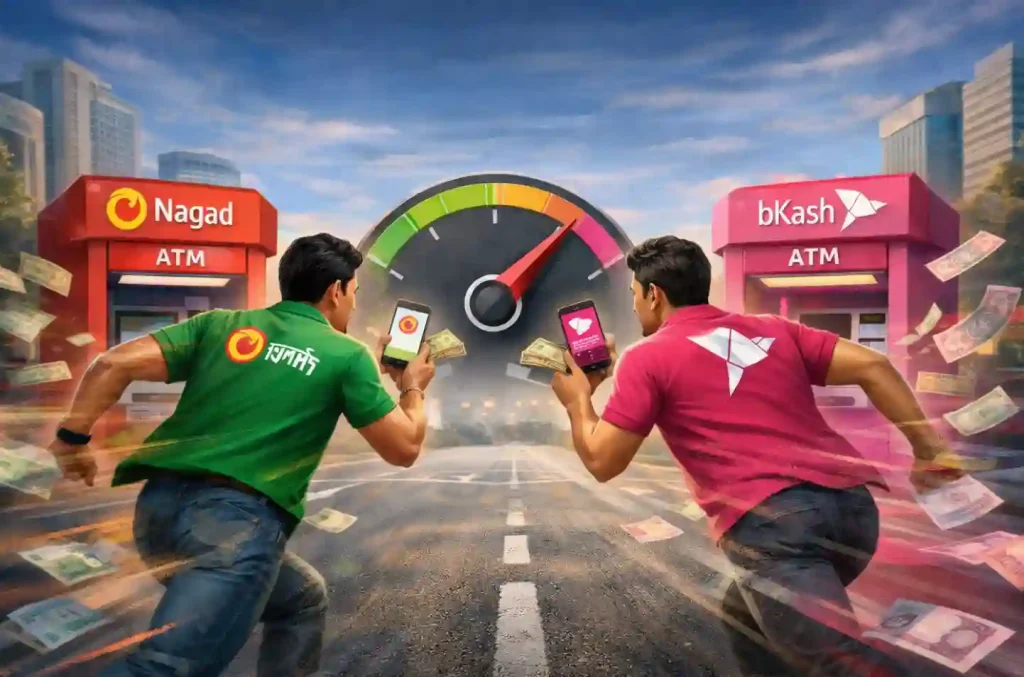
But in reality, speed is a fickle thing. It doesn’t depend on a legend; it depends on exactly when you make the transaction and how congested the day is. I noticed this not through official “reports” or spreadsheets, but through a recurring everyday pattern: one wallet glides through at certain times, while the other starts to stall.
How it Usually Works in Practice
For many, the relationship with bKash is like visiting a massive central market: it has everything, it’s familiar, but during peak hours, you find yourself standing in a crowd, waiting for the queue to budge.Nagad feels different: like finding a slightly quieter entrance on a side street. It isn’t always “faster at everything,” but sometimes it’s just smoother. This is especially true when everyone is doing the same thing at once: sending money home, paying for the internet, topping up mobile credit, or moving small BDT amounts back and forth.
Observations of the Month (Based on Feel, Not Figures)
To be honest, after a month of use, a simple picture emerged: during off-peak hours, both wallets behave consistently. Transactions go through quickly without unnecessary waiting.
A Quick Chat on Messenger (The Usual Explanation)
- Me: “Why does one wallet lag in the evening while the other is more responsive?”
- Him: “Because in the evening, everyone is doing the same thing. Mass transfers, bill payments, top-ups. A major service has a longer queue – that’s all the magic there is to it.”
- Me: “So it’s not that one is ‘better,’ it’s just that one is ‘more congested’?”
- Him: “Exactly. Plus, it depends on how a specific site triggers confirmations. Sometimes the delay isn’t the wallet’s fault at all; it’s on the platform’s side.”
- Me: “So what’s the move?”
- Him: “Keep both. Then you aren’t dependent on the mood of the evening.”
This “keep both” advice sounds dull, but in real life, it works better than any debate.
Why Delays Often Look Like the “Wallet’s Fault” (Even When They Aren’t)
There is another reason people blame bKash or Nagad unfairly: the interface of the casino or bookmaker shows “pending,” and it looks like the money is stuck “in the wallet.”But sometimes the delay is actually how the platform updates the status:
- The request is sent.
- The confirmation doesn’t pull through immediately.
- The screen updates after a pause.
The user sits there, glaring at their phone and getting angry at the mobile wallet – when in fact, several systems are “thinking” at the same time.
The Verdict: Not Choosing the “Best,” but a Personal Compromise
To keep it short, this has turned into a matter of daily discipline for me: I keep both wallets.
- bKash – because it really is “everywhere” and is often convenient out of habit.
- Nagad – because at certain times it feels calmer, and it saves my nerves when I don’t want to wait.
This is perhaps the most honest conclusion without the hype: in Bangladesh, it’s often the moment, not the brand, that decides things. When the day gets busy, the most practical option is to have a second pocket.